Hello one and all,
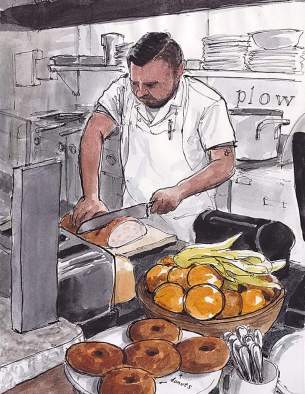
My name is Chef Matthew Schutten-Burt. I’m a Canadian chef with 15 years of experience on the line. I’ve worked across the country as well as in the UK. I work, currently, at http://www.garlicsoflondon.com under Head Chef Carla Cooper, where I function as the morning chef. My team and I are responsible for bread shift, desserts, set up, lunch service and all the butchering. Formerly, I was the sous-chef at http://www.dinkels.ca and the attached restaurant, Paulo’s Italian Trattoria.
I was asked to write a piece by Chef Noel on any topic I so chose and I think I’ve come up with an important one for both male and female chefs.
First things first, it’s important to note that I’m not…politically correct. I don’t go out of my way to offend anyone, surely, but I also feel the need to be direct in what I’m going to say because it is of, I believe, utmost importance.
We aren’t going to talk about food today. Nor are we talking about any new technique, method, recipe or ingredient, we aren’t even going to address the Business itself, but rather our actions within it.
Today, now more than ever, our actions are under constant scrutiny. We have health inspectors, TripAdvisor, Yelp and a whole host of food blogs, YouTubers and Twitter users who have the ability to let others know what they think about our food in an instant.
This is on top of the already demanding specifications it takes to make it into the likes of the AA Food Guide, or even appear on Michelin’s radar, and I’d argue the blogger and twitter-er can do more damage to a restaurant than either “major” group can. That is to say, there are plenty of successful restaurants that make their owners millions without a rep ever setting foot in the dining room.
Thus, we come nicely to my topic: professionalism.
What do I mean by this word? Simply this; how we interact with each-other, FOH and our punters, whether behind closed doors or in full view of our dining rooms.
Never before have we been watched so carefully. Our profession, due to the likes of Chef Ramsay and Chef Oliver among others, has been shot to the forefront of pop culture. Yet never more have we been thought of less for our craft and more for the shenanigans that have been brought to light and have, for all intents and purposes, become tropes and memes of culinary culture.
It is expected of us to shout, to scream and the swear. We are expected to belittle our co-workers, to behave as children and over-dramatic actors. It can be argued, and, in fact I AM
arguing, that chefs such as Gordon Ramsay have done more harm than good for our trade over the last few years.
Certainly he is innovative, and his food is par excellence, but one cannot, cannot, cannot look away from the antics and showmanship that is demonstrated on American television through Kitchen Nightmares and Hell’s Kitchen.
Is the face that American telly puts on for us our true persona as culinary wolves? No. It is, however, what sells in America. One needs only look as far as what British television shows to know that this isn’t the case. The UK version of Kitchen Nightmares is far different. Being Canadian, I’m blessed to get access to both.
But sadly, it’s usually the vocal, crass and often loud minority that draws attention to itself. The squeaky wheel gets the grease and all that.
But in this case I think it is imperative to be the solution ourselves, rather than just stand by and let the customer and the media portray us how they want. We are professionals and, if you’re reading Noel’s blog, I have to assume you’ve CHOSEN this career path, not been forced into it.
Your pride should genuinely be hurt by the low, base and unexceptional level that is not only expected of us, but (in some cases) looked for.
There is, however, a remedy for this.
We need to treat ourselves, firstly, with respect. It is impossible to function and work in a high-stress, fast-paced, often hot and exhausting environment unless you look yourself in the mirror every day and say “I can do this. I’ve got this. I’m well trained. My crew has my back, and I’ve trained them well. We know our roles, we know our staff, we know our menu.” Only when you can do this can you move on to step two.
Secondly, treat your under-chefs with respect. Don’t talk down to them. Talk WITH them. Certainly, when the heat is on, expect a “Yes, Chef!” from them, but don’t call them out in front of the rest of the crew. That kind of action gets passed around to those who weren’t there as the night’s juicy gossip. Talk to them after service. Work on the issue together, and never in hearing range of others. Most of us have offices. We should make use of them.
Please note there is a caveat here. Some people just don’t fit, and the level of insubordination can get insane. If you must remove somebody from line for the sake of customers and staff, do so. Firmly, calmly. Let them make the noise. Retain your composure.
Thirdly, be kind to your servers and, through them, the customer.
FOH is the link you have to the customer. Without them you can’t get food out of the pass, let alone get orders in to the kitchen. They tell you about allergies, dietary restrictions and modifications. Granted, most of these are irritating, but if the customer comes back, or stays longer buying booze and dessert, who gives a damn? We exist to make money. We have a skill
we are passionate about that people are willing to pay for. Respect the servers and the (reasonable requests) of your customers and they’ll be singing your praises.
This may all seem like common sense, but I think it bears repeating. Especially in light of how trainee chefs are coming out of catering college these days. I don’t know the current situation in Europe or in the UK, but here? It’s a disaster.
These…petulant and petty youngsters are coming out like puffed-up little school children, not realizing that finishing catering college is only the first rung on a very, VERY long ladder.
If you’re a trainee chef and reading this, check your ego. I’m not concerned with how good you think you are, there’s always someone else who’s better, and if there isn’t? Quit now. You’ve peaked. It is important to look at every shift, every service, every day as an opportunity to improve upon your skills and learn some new ones. Only then will you begin to be thought of as worth your salt by your superiors.
Bottom line, chefs? Be excellent to each other and your staff. We have little home life, leave our spouses and children alone when we wish we didn’t. We miss birthdays, anniversaries, valentines, new years and football games. We miss Christmas Pantos. We miss baptisms. We miss graduations and vacations.
And sometimes…well, this causes our home lives to collapse. When this happens, we only have each other. Our families extend beyond our homes. You know this. And you know we forgive the worst offences from each other because of it. But, let’s not abuse it, shall we? Each one of us may come to a day where our restaurant family is all we have for that moment.
Until next time, chefs,
Take care,
Chef Matthew Schutten-Burt
Garlic’s of London
London, Ontario
Canada
follow matthew on twitter @matthewjburt



 traleeculinarygangsters