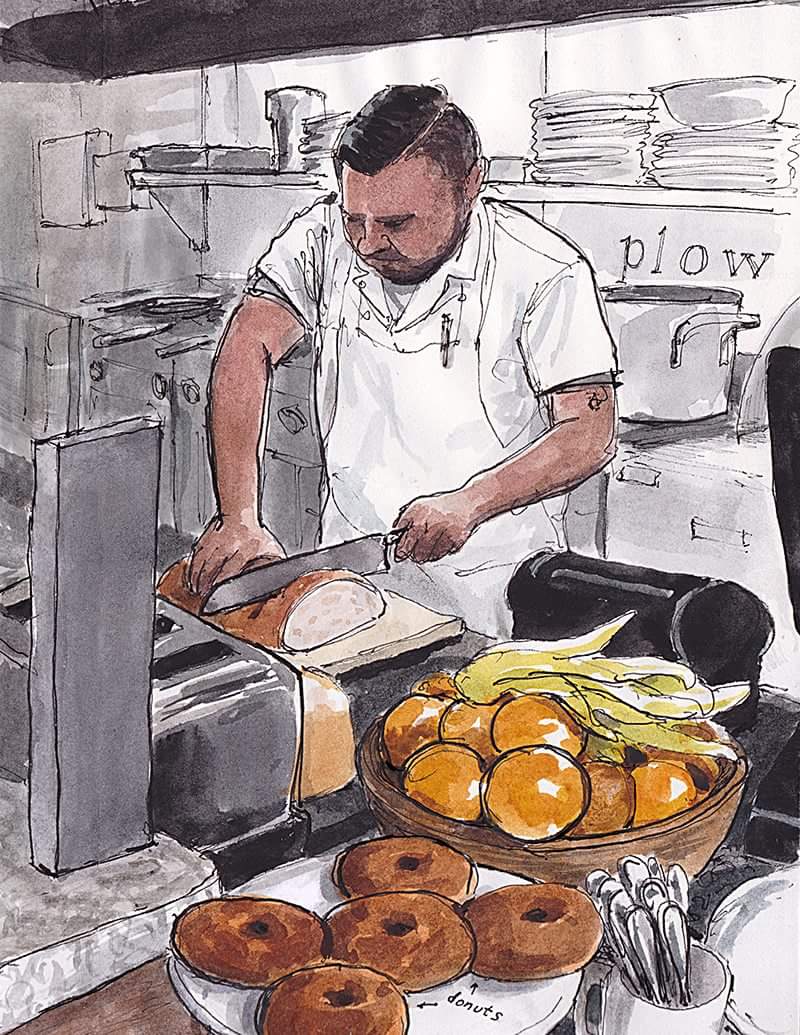
front of house maestro Pawel given us a coffee lesson
*** History of coffee
The Coffee Bearer by John Frederick Lewis (1857).
(Ottoman quarters in Cairo, Egypt)
The history of coffee goes at least as far back as the 10th century, with a number of reports and legends surrounding its first use. The native (undomesticated) origin of coffee is thought to have been Ethiopia. The earliest substantiated evidence of either coffee drinking or knowledge of the coffee tree is from the 15th century, in the Sufi monasteries of Yemen.[1] By the 16th century, it had reached the rest of the Middle East, Persia, Turkey, Horn of Africa, and northern Africa. Coffee then spread to the Balkans, Italy and to the rest of Europe, to Indonesia and then to America.[2]
Etymology
The word “coffee” entered the English language in 1582 via the Dutch koffie,[3] borrowed from the Turkish kahve, in turn borrowed from the Arabic qahwah ( قهوة).[4]
The word qahwah originally referred to a type of wine, whose etymology is given by Arab lexicographers as deriving from the verb qahā (قها, “to lack hunger”) in reference to the drink’s reputation as an appetite suppressant.[4][5] The word qahwah is sometimes alternatively traced to the Arabic quwwa (“power, energy”), or to Kaffa, a medieval kingdom in Ethiopia whence the plant was exported to Arabia.[4] These etymologies for qahwah have all been disputed, however. The name qahwah is not used for the berry or plant (the products of the region), which are known in Arabic as bunn and in Oromo as būn. Semitic had a root qhh “dark color”, which became a natural designation for the beverage. According to this analysis, the feminine form qahwah (also meaning “dark in color, dull(ing), dry, sour”) was likely chosen to parallel the feminine khamr (خمر, “wine”), and originally meant “the dark one”.[6]
First use
The Ethiopian ancestors of today’s Oromo ethnic group were the first to have recognized the energizing effect of the native coffee plant.[1] Studies of genetic diversity have been performed on Coffea arabica varieties, which were found to be of low diversity but with retention of some residual heterozygosity from ancestral materials, and closely related diploid species Coffea canephora and C. liberica;[7] however, no direct evidence has ever been found indicating where in Africa coffee grew or who among the natives might have used it as a stimulant or known about it there earlier than the seventeenth century.[1] The original domesticated coffee plant is said to have been from Harar, and the native population is thought to be derived from Ethiopia with distinct nearby populations in Sudan and Kenya.[8][9]
Coffee was primarily consumed in the Islamic world where it originated and was directly related to religious practices.[10]
There are several legendary accounts of the origin of the drink itself. One account involves the Yemenite Sufi mystic Ghothul Akbar Nooruddin Abu al-Hasan al-Shadhili.[11] When traveling in Ethiopia, the legend goes, he observed birds of unusual vitality, and, upon trying the berries that the birds had been eating, experienced the same vitality.
Other accounts attribute the discovery of coffee to Sheik Abou’l Hasan Schadheli’s disciple, Omar. According to the ancient chronicle (preserved in the Abd-Al-Kadir manuscript), Omar, who was known for his ability to cure the sick through prayer, was once exiled from Mocha to a desert cave near Ousab. Starving, Omar chewed berries from nearby shrubbery, but found them to be bitter. He tried roasting the beans to improve the flavor, but they became hard. He then tried boiling them to soften the bean, which resulted in a fragrant brown liquid. Upon drinking the liquid Omar was revitalized and sustained for days. As stories of this “miracle drug” reached Mocha, Omar was asked to return and was made a saint.[12]
Another probably fanciful[1] account involves a 9th-century Ethiopian goat-herder, Kaldi, who, noticing the energizing effects when his flock nibbled on the bright red berries of a certain bush, chewed on the fruit himself. His exhilaration prompted him to bring the berries to a monk in a nearby monastery. But the monk disapproved of their use and threw them into the fire, from which an enticing aroma billowed, causing other monks to come and investigate. The roasted beans were quickly raked from the embers, ground up, and dissolved in hot water, yielding the world’s first cup of coffee. Since this story is not known to have appeared in writing before 1671, 800 years after it was supposed to have taken place, it is highly likely to be apocryphal.[1]
History
Syrian Bedouin from a beehive village in Aleppo, Syria, sipping the traditional murra (bitter) coffee, 1930
Palestinian women grinding coffee, 1905
The earliest credible evidence of either coffee drinking or knowledge of the coffee tree appears in the middle of the 15th century, in Yemen’s Sufi monasteries.[1]
Coffee beans were first exported from Ethiopia to Yemen. Yemeni traders brought coffee back to their homeland and began to cultivate the bean.[13] The word qahwa originally meant wine, and Sufis in Yemen used the beverage as an aid to concentration and as a kind of spiritual intoxication when they chanted the name of God.[14] Sufis used it to keep themselves alert during their nighttime devotions. A translation of Al-Jaziri’s manuscript[15] traces the spread of coffee from Arabia Felix (the present day Yemen) northward to Mecca and Medina, and then to the larger cities of Cairo, Damascus, Baghdad, and Constantinople. By 1414, the beverage was known in Mecca, and in the early 1500s was spreading to the Mameluke Sultanate of Egypt and North Africa from the Yemeni port of Mocha.[8][14] Associated with Sufism, a myriad of coffee houses grew up in Cairo (Egypt) around the religious University of the Azhar. These coffee houses also opened in Syria, especially in the cosmopolitan city of Aleppo,[14] and then in Istanbul, the capital of the Ottoman Empire, in 1554.[14] In 1511, it was forbidden for its stimulating effect by conservative, orthodox imams at a theological court in Mecca.[16] However, these bans were to be overturned in 1524 by an order of the Ottoman Turkish Sultan Suleiman I, with Grand Mufti Mehmet Ebussuud el-İmadi issuing a fatwa allowing the consumption of coffee.[17] In Cairo, Egypt, a similar ban was instituted in 1532, and the coffeehouses and warehouses containing coffee beans were sacked.[18] During the 16th century, it had already reached the rest of the Middle East, the Safavid Empire and the Ottoman Empire. From the Middle East, coffee drinking spread to Italy, then to the rest of Europe, and coffee plants were transported by the Dutch to the East Indies and to the Americas.[2]
Similarly, coffee was banned by the Ethiopian Orthodox Church some time before the 18th century.[19] However, in the second half of the 19th century, Ethiopian attitudes softened towards coffee drinking, and its consumption spread rapidly between 1880 and 1886; according to Richard Pankhurst, “this was largely due to Emperor Menilek, who himself drank it, and to Abuna Matewos who did much to dispel the belief of the clergy that it was a Muslim drink.”[20]
The earliest mention of coffee noted by the literary coffee merchant Philippe Sylvestre Dufour[21] is a reference to bunchum in the works of the 10th century CE Persian physician Muhammad ibn Zakariya al-Razi, known as Rhazes in the West,[22] but more definite information on the preparation of a beverage from the roasted coffee berries dates from several centuries later. One of the most important of the early writers on coffee was Abd al-Qadir al-Jaziri, who in 1587 compiled a work tracing the history and legal controversies of coffee entitled Umdat al safwa fi hill al-qahwa عمدة الصفوة في حل القهوة.[16][23] He reported that one Sheikh, Jamal-al-Din al-Dhabhani (d. 1470), mufti of Aden, was the first to adopt the use of coffee (circa 1454).
He found that among its properties was that it drove away fatigue and lethargy, and brought to the body a certain sprightliness and vigour.[1]
Europe
Dutch engraving of Mocha in 1692
Coffee was noted in Aleppo by the German physician botanist Leonhard Rauwolf, the first European to mention it, as chaube, in 1573; Rauwolf was closely followed by descriptions from other European travellers.[24]
The vibrant trade between the Republic of Venice and the Muslims in North Africa, Egypt, and the East brought a large variety of African goods, including coffee, to this leading European port. Venetian merchants introduced coffee-drinking to the wealthy in Venice, charging them heavily for the beverage. In this way, coffee was introduced to Europe. The first European coffee house apart from those in the Ottoman Empire was opened in Venice in 1645.[2]
Austria
The first coffeehouse in Austria opened in Vienna in 1683 after the Battle of Vienna, by using supplies from the spoils obtained after defeating the Turks. The officer who received the coffee beans, Jerzy Franciszek Kulczycki, a Polish military officer of Ukrainian origin, opened the coffee house and helped popularize the custom of adding sugar and milk to the coffee. Melange is the typical Viennese coffee, which comes mixed with hot foamed milk and a glass of water.
England
1652 advertisement for the UK’s first coffeehouse, St. Michael’s Alley
According to Leonhard Rauwolf’s 1583 account, coffee became available in England no later than the 16th century, largely through the efforts of the British East India Company and the Dutch East India Company. The first coffeehouse in England was opened in St. Michael’s Alley in Cornhill, London. The proprietor was Pasqua Rosée, the servant of Daniel Edwards, a trader in Turkish goods. Edwards imported the coffee and assisted Rosée in setting up the establishment. Oxford’s Queen’s Lane Coffee House, established in 1654, is still in existence today. By 1675, there were more than 3,000 coffeehouses throughout England, but there were many disruptions in the progressive movement of coffeehouses between the 1660s and 1670s.[25] During the enlightenment, these early English coffee houses became gathering places used for deep religious and political discussions among the populace. This practice became so common, and potentially subversive, that Charles II made an attempt to crush coffee houses in 1675.[26][27][28][29]
The banning of women from coffeehouses was not universal, for example, women frequented them in Germany, but it appears to have been commonplace elsewhere in Europe, including in England.[30]
Many in this period believed coffee to have medicinal properties. A 1661 tract entitled “A character of coffee and coffee-houses”, written by one “M.P.”, lists some of these perceived benefits:
‘Tis extolled for drying up the Crudities of the Stomack, and for expelling Fumes out of the Head. Excellent Berry! which can cleanse the English-man’s Stomak of Flegm, and expel Giddinesse out of his Head.
This new commodity proved controversial among some subjects, however. For instance, the anonymous 1674 “Women’s Petition Against Coffee” declared:
the Excessive Use of that Newfangled, Abominable, Heathenish Liquor called COFFEE …has…Eunucht our Husbands, and Crippled our more kind Gallants, that they are become as Impotent, as Age.[31]
France
Antoine Galland (1646–1715) in his aforementioned translation described the Muslim association with coffee, tea and chocolate: “We are indebted to these great [Arab] physicians for introducing coffee to the modern world through their writings, as well as sugar, tea, and chocolate.” Galland reported that he was informed by Mr. de la Croix, the interpreter of King Louis XIV of France, that coffee was brought to Paris by a certain Mr. Thevenot, who had travelled through the East. On his return to that city in 1657, Thevenot gave some of the beans to his friends, one of whom was de la Croix.
In 1669, Soleiman Agha, Ambassador from Sultan Mehmed IV, arrived in Paris with his entourage bringing with him a large quantity of coffee beans. Not only did they provide their French and European guests with coffee to drink, but they also donated some beans to the royal court. Between July 1669 and May 1670, the Ambassador managed to firmly establish the custom of drinking coffee among Parisians.
Germany
In Germany, coffeehouses were first established in North Sea ports, including Bremen (1673) and Hamburg (1677). Initially, this new beverage was written in the English form coffee, but during the 1700s the Germans gradually adopted the French word café, then slowly changed to the word Kaffee, where it stands now. In the 18th century the popularity of coffee gradually spread around the German lands, and was taken up by the ruling classes. Coffee was served at the court of the Great Elector, Frederick William of Brandenburg, as early as 1675, but the first public coffee house in his capital, Berlin, opened only in 1721.
Café Zimmermann, Leipzig (engraving by Johann Georg Schreiber, 1732)
Composer Johann Sebastian Bach, who was cantor of St. Thomas Church, Leipzig, in 1723–50, conducted a musical ensemble at Café Zimmermann in that Saxon city. Sometime in 1732–35 he composed the secular “Coffee Cantata” Schweigt stille, plaudert nicht (BWV 211), in which a young woman, Lieschen, pleads with her disapproving father to accept her devotion to drinking coffee, then a newfangled fashion. The libretto includes such lines as:
Ei! wie schmeckt der Coffee süße,
Lieblicher als tausend Küsse,
Milder als Muskatenwein.
Coffee, Coffee muss ich haben,
Und wenn jemand mich will laben,
Ach, so schenkt mir Coffee ein!
(Oh! How sweet coffee does taste,
Better than a thousand kisses,
Milder than muscat wine.
Coffee, coffee, I’ve got to have it,
And if someone wants to perk me up, *
Oh, just give me a cup of coffee!)
Netherlands
Further information: Dutch East India Company
The race among Europeans to obtain live coffee trees or beans was eventually won by the Dutch in 1616. Pieter van den Broecke, a Dutch merchant, obtained some of the closely guarded coffee bushes from Mocha, Yemen, in 1616. He took them back to Amsterdam and found a home for them in the Botanical gardens, where they began to thrive. This apparently minor event received little publicity, but was to have a major impact on the history of coffee.
The beans that van der Broecke acquired from Mocha forty years earlier adjusted well to conditions in the greenhouses at the Amsterdam Botanical Garden and produced numerous healthy Coffea arabica bushes. In 1658 the Dutch first used them to begin coffee cultivation in Ceylon (now Sri Lanka) and later in southern India. They abandoned these cultivations to focus on their Javanese plantations in order to avoid lowering the price by oversupply.[citation needed]
Within a few years, the Dutch colonies (Java in Asia, Suriname in the Americas) had become the main suppliers of coffee to Europe.
Poland
Coffee reached the Polish–Lithuanian Commonwealth in 17th century, primarily through merchants trading with the Ottomans.[32] First coffee shops opened a century later.[33] Usage of coffee has grown since, though it was a luxury commodity during the communist era of the Polish People’s Republic. Consumption of coffee has grown since the transformation of Poland into a democratic, capitalistic country in 1989, through it still remains lower per capita than in most West European countries.[34]
Americas
Gabriel de Clieu brought coffee seedlings to Martinique in the Caribbean circa 1720. Those sprouts flourished and 50 years later there were 18,680 coffee trees in Martinique enabling the spread of coffee cultivation to Saint-Domingue (Haiti), Mexico and other islands of the Caribbean. The French territory of Saint-Domingue, saw coffee cultivated from 1734, and by 1788 it supplied half the world’s coffee. Coffee had a major influence on the geography of Latin America.[35] The French colonial plantations relied heavily on African slave laborers. However, the dreadful conditions that the slaves worked in on coffee plantations were a factor in the soon-to-follow Haitian Revolution. The coffee industry never fully recovered there.[36]
Coffee also found its way to the Isle of Bourbon, now known as Réunion, in the Indian Ocean. The plant produced smaller beans and was deemed a different variety of arabica known as var. Bourbon. The Santos coffee of Brazil and the Oaxaca coffee of Mexico are the progeny of that Bourbon tree. Circa 1727, the King of Portugal sent Francisco de Melo Palheta to French Guiana to obtain coffee seeds to become a part of the coffee market. Francisco initially had difficulty obtaining these seeds, but he captivated the French Governor’s wife and she sent him enough seeds and shoots to commence the coffee industry of Brazil. In 1893, the coffee from Brazil was introduced into Kenya and Tanzania (Tanganyika), not far from its place of origin in Ethiopia, 600 years prior, ending its transcontinental journey.[37]
Meanwhile, coffee had been introduced to Brazil in 1727, although its cultivation did not gather momentum until independence in 1822.[38] After this time, massive tracts of rainforest were cleared first from the vicinity of Rio and later São Paulo for coffee plantations.[39]
After the Boston Tea Party of 1773, large numbers of Americans switched to drinking coffee during the American Revolution because drinking tea had become unpatriotic.[40]
Cultivation was taken up by many countries in the latter half of the 19th century, and almost all involved the large-scale displacement and exploitation of the indigenous Indian people. Harsh conditions led to many uprisings, coups and bloody suppression of peasants.[41] The notable exception was Costa Rica, where lack of ready labor prevented the formation of large farms. Smaller farms and more egalitarian conditions ameliorated unrest over the 19th and 20th centuries.[42]
Brazil became the largest producer of coffee in the world by 1852 and it held that status ever since. It dominated world production, exporting more coffee than the rest of the world combined, from 1850 to 1950. The period since 1950 saw the widening of the playing field due to the emergence of several other major producers, most notably Colombia, Ivory Coast, Ethiopia, and, most recently, Vietnam, which overtook Colombia and became the second-largest producer in 1999 and reached 15% market share by 2011.[43]
Asia
India
Monsooned Malabar arabica, compared with green Yirgachefe beans from Ethiopia
The first record of coffee growing in India is following the introduction of coffee beans from Yemen by Baba Budan to the hills of Chikmagalur in 1670.[44] Since then coffee plantations have become established in the region, extending south to Kodagu.
Coffee production in India is dominated in the hill tracts of South Indian states, with the state of Karnataka accounting 53% followed by Kerala 28% and Tamil Nadu 11% of production of 8,200 tonnes. Indian coffee is said to be the finest coffee grown in the shade rather than direct sunlight anywhere in the world.[45] There are approximately 250,000 coffee growers in India; 98% of them are small growers.[46] As of 2009, the production of coffee in India was only 4.5% of the total production in the world. Almost 80% of the country’s coffee production is exported.[47] Of that which is exported, 70% is bound for Germany, Russian federation, Spain, Belgium, Slovenia, United States, Japan, Greece, Netherlands and France, and Italy accounts for 29% of the exports. Most of the export is shipped through the Suez Canal.[45]
Coffee is grown in three regions of India with Karnataka, Kerala and Tamil Nadu forming the traditional coffee growing region of South India, followed by the new areas developed in the non-traditional areas of Andhra Pradesh and Orissa in the eastern coast of the country and with a third region comprising the states of Assam, Manipur, Meghalaya, Mizoram, Tripura, Nagaland and Arunachal Pradesh of Northeastern India, popularly known as “Seven Sister States of India”.[48]
Indian coffee, grown mostly in southern India under monsoon rainfall conditions, is also termed as “Indian monsooned coffee”. Its flavour is defined as: “The best Indian coffee reaches the flavour characteristics of Pacific coffees, but at its worst it is simply bland and uninspiring”.[49] The two well known species of coffee grown are the Arabica and Robusta. The first variety that was introduced in the Baba Budan Giri hill ranges of Karnataka in the 17th century[50] was marketed over the years under the brand names of Kent and S.795.
Chikmagalur Coffee is the cornerstone of Chikmagalur’s economy. Chikmagalur is the birthplace of coffee in India, where the seed was first sown about 350 years ago. Coffee Board is the department located in Chikmagalur town that oversees the production and marketing of coffee cultivated in the district. Coffee is cultivated in Chikmagalur district in an area of around 85,465 hectares with Arabica being the dominant variety grown in upper hills and Robusta being the major variety in the low level hills. There are around 15000 coffee growers in this district with 96% of them being small growers with holdings of less than or equal to 4 hectares. The average production is 55,000 MT: 35,000 MT of Arabica and 20,000 MT of Robusta. The average productivity per hectare is 810 kg for Arabica and 1110 kg of Robusta, which are higher than the national average. Arabica is a species of coffee that is also known as the “coffee shrub of Arabia”, “mountain coffee” or “arabica coffee”. Coffea arabica is believed to be the first species of coffee to be cultivated, being grown in southwest Arabia for well over 1,000 years. It is considered to produce better coffee than the other major commercially grown coffee species, Coffea canephora (robusta). Arabica contains less caffeine than any other commercially cultivated species of coffee. Robusta is a species of coffee which has its origins in western Africa. It is grown mostly in Africa and Brazil, where it is often called Conillon. It is also grown in Southeast Asia where French colonists introduced it in the late 19th century. In recent years Vietnam, which only produces robusta, has surpassed Brazil, India, and Indonesia to become the world’s single largest exporter. Approximately one third of the coffee produced in the world is robusta.
Japan
Coffee was introduced to Japan by the Dutch in the 17th century, but remained a curiosity until the lifting of trade restrictions in 1858. The first European-style coffeehouse opened in Tokyo in 1888, and closed four years later.[51] By the early 1930s there were over 30,000 coffeehouses across the country; availability in the wartime and immediate postwar period dropped to nearly zero, then rapidly increased as import barriers were removed. The introduction of freeze-dried instant coffee, canned coffee, and franchises such as Starbucks and Doutor Coffee in the late 20th century continued this trend, to the point that Japan is now one of the leading per capita coffee consumers in the world.[52]
South Korea
Coffee’s first notable Korean enthusiasts were 19th century emperors Sunjong and Gojong, who preferred to consume it after western-style banquets.[53] By the 1980s instant coffee and canned coffee had become fairly popular, with a more minor tradition of independently owned coffeehouses in larger cities; toward the end of the century the growth of franchises such as Caffe Bene and Starbucks brought about a greater demand for European-style coffee.[54]
Indonesia
Coffee was first introduced by the Dutch during colonization. Today Indonesia is one of the largest coffee producers in the world, mainly for export. However coffee is enjoyed in various ways around the archipelago like traditional “Kopi Ende” which is with ginger to fancy new ways in Jakartas many coffee shops like Anomali.
Production
The first step in Europeans’ wresting the means of production was effected by Nicolaes Witsen, the enterprising burgomaster of Amsterdam and member of the governing board of the Dutch East India Company who urged Joan van Hoorn, the Dutch governor at Batavia that some coffee plants be obtained at the export port of Mocha in Yemen, the source of Europe’s supply, and established in the Dutch East Indies;[55] the project of raising many plants from the seeds of the first shipment met with such success that the Dutch East India Company was able to supply Europe’s demand with “Java coffee” by 1719.[56] Encouraged by their success, they soon had coffee plantations in Ceylon, Sumatra and other Sunda islands.[57] Coffee trees were soon grown under glass at the Hortus Botanicus of Leiden, whence slips were generously extended to other botanical gardens. Dutch representatives at the negotiations that led to the Treaty of Utrecht presented their French counterparts with a coffee plant, which was grown on at the Jardin du Roi, predecessor of the Jardin des Plantes, in Paris.
The introduction of coffee to the Americas was effected by Captain Gabriel des Clieux, who obtained cuttings from the reluctant botanist Antoine de Jussieu, who was loath to disfigure the king’s coffee tree.[58] Clieux, when water rations dwindled during a difficult voyage, shared his portion with his precious plants and protected them from a Dutchman, perhaps an agent of the Provinces jealous of the Batavian trade.[59] Clieux nurtured the plants on his arrival in the West Indies, and established them in Guadeloupe and Saint-Domingue in addition to Martinique, where a blight had struck the cacao plantations, which were replaced by coffee plantations in a space of three years, is attributed to France through its colonization of many parts of the continent starting with the Martinique and the colonies of the West Indies where the first French coffee plantations were founded.
The first coffee plantation in Brazil occurred in 1727 when Lt. Col. Francisco de Melo Palheta smuggled seeds, still essentially from the germ plasm originally taken from Yemen to Batavia,[60] from French Guiana. By the 1800s, Brazil’s harvests would turn coffee from an elite indulgence to a drink for the masses. Brazil, which like most other countries cultivates coffee as a commercial commodity, relied heavily on slave labor from Africa for the viability of the plantations until the abolition of slavery in 1888. The success of coffee in 17th-century Europe was paralleled with the spread of the habit of tobacco smoking all over the continent during the course of the Thirty Years’ War (1618–1648).
For many decades in the 19th and early 20th centuries, Brazil was the biggest producer of coffee and a virtual monopolist in the trade. However, a policy of maintaining high prices soon opened opportunities to other nations, such as Colombia,[61] Guatemala, Nicaragua, Indonesia and Vietnam, now second only to Brazil as the major coffee producer in the world. Large-scale production in Vietnam began following normalization of trade relations with the US in 1995.[62] Nearly all of the coffee grown there is Robusta.[63]
Despite the origins of coffee cultivation in Ethiopia, that country produced only a small amount for export until the Twentieth Century, and much of that not from the south of the country but from the environs of Harar in the northeast. The Kingdom of Kaffa, home of the plant, was estimated to produce between 50,000 and 60,000 kilograms of coffee beans in the 1880s. Commercial production effectively began in 1907 with the founding of the inland port of Gambela. 100,000 kilograms of coffee was exported from Gambela in 1908, while in 1927–8 over 4 million kilograms passed through that port.[64] Coffee plantations were also developed in Arsi Province at the same time, and were eventually exported by means of the Addis Ababa – Djibouti Railway. While only 245,000 kilograms were freighted by the Railway, this amount jumped to 2,240,000 kilograms by 1922, surpassed exports of “Harari” coffee by 1925, and reached 9,260,000 kilograms in 1936.[65]
Australia is a minor coffee producer, with little product for export, but its coffee history goes back to 1880 when the first of 500 acres (2.0 km2) began to be developed in an area between northern New South Wales and Cooktown. Today there are several producers of Arabica coffee in Australia that use a mechanical harvesting system invented in 1981.